Here are the six major pillars of secondary mathematics
Here is a comprehensive list and explanation of secondary school maths topics
Here are the six major pillars of secondary mathematics
 Pillar 1: Number and Operations (The Foundation)
Types of Numbers:
- Content: Defining natural numbers, integers (positive and negative), rational numbers (fractions/decimals), and irrational numbers (like π or √2).
- Why it matters: Knowing which number system you are working in is crucial for knowing which rules apply.
Indices (Exponents) and Roots:
- Content: The laws of indices (multiplying powers, negative powers, fractional powers like $x^{1/2}$) and simplifying surds (roots).
- Why it matters: This is the grammar of advanced algebra and science equations.
Standard Form (Scientific Notation):
- Content: Writing very large or very small numbers efficiently (e.g., $3 \times 10^8$).
- Why it matters: Essential for physics, chemistry, and understanding real-world data like populations or microscopic distances.
Fractions, Decimals, and Percentages:
- Content: Converting between them, calculating percentage change (increase/decrease), reverse percentages, and compound interest.
- Why it matters: The most practical "real-world" Mathematics strand used in finance, shopping, and news reporting.
Pillar 2: Algebra (The Language of Maths)
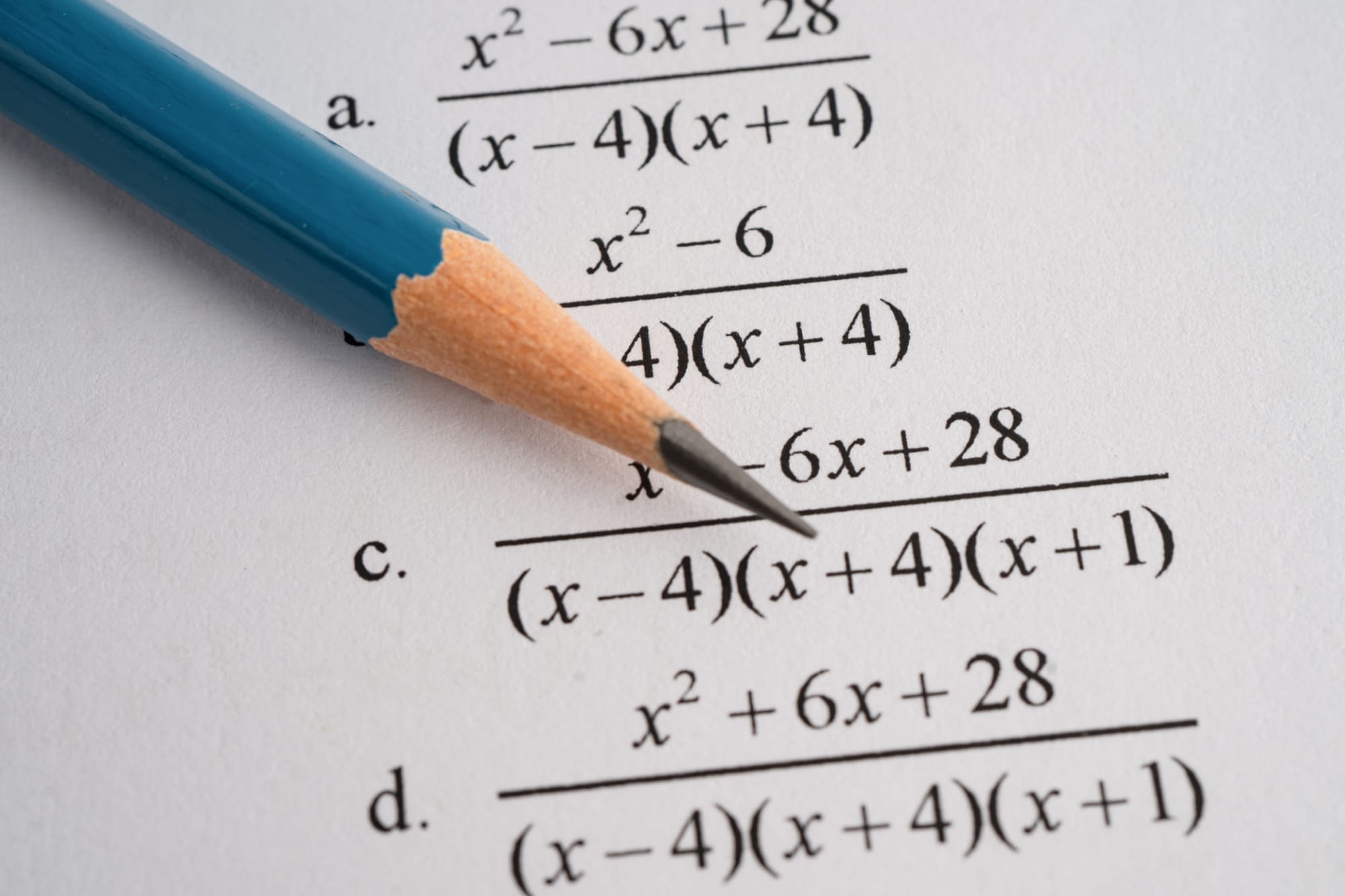 Algebra is generalised arithmetic. It uses symbols to represent unknown quantities and relationships.
Algebraic Expressions:
- Content: Collecting like terms, expanding brackets (FOIL method), and factorisation (taking common factors out).
- Why it matters: The basic "cleanup" toolkit required before solving any equation.
- Linear Equations and Inequalities:
- Content: Solving for $x$ in equations like $3x + 5 = 20$, and handling inequalities ($<, >, \leq, \geq$) and showing them on a number line.
- Why it matters: Finding a single unknown value
- based on known constraints.
- Formulas and Rearranging:
- Content: Substituting values into scientific or geometric formulas and changing the subject of a formula (e.g., making $r$ the subject in $A = \pi r^2$).
- Why it matters: Crucial for science subjects where you need to manipulate equations to find what you are looking for.
- Quadratic Equations:
- Content: Dealing with equations with an $x^2$ term. Solving them via factorizing, completing the square, and using the Quadratic Formula.
- Why it matters: Used to model things that go up and come down (like a thrown ball) or optimize areas.
- Simultaneous Equations (Systems of Equations):
- Content: Solving two equations with two unknowns at the same time using substitution or elimination methods.
- Why it matters: Finding the "intersection point" where two different conditions are met instantly (e.g., comparing two mobile phone plans to see where they cost the same).
- Sequences and Series:
- Content: Finding patterns in numbers. Arithmetic progressions (adding the same amount) and Geometric progressions (multiplying by the same amount). finding the $n$-the term.
- Why it matters: Used in predicting future trends, finance, and computer science patterns.
Pillar 3: Geometry and Measures (Space and Shape)
This strand focuses on visualising the physical world, understanding properties of shapes, and quantifying space.
Angles and Lines:
- Content: Properties of parallel lines (alternate, corresponding angles), angles in triangles and polygons.
- Why it matters: The foundation of construction, architecture, and design.
2D Shapes (Polygons):
- Content: Properties of quadrilaterals (squares, rhombuses, trapeziums). Calculating Area and Perimeter.
- Why it matters: Essential for measuring land, flooring, painting, etc.
Circles:
- Content: Circumference ($C=\pi d$) and Area ($A=\pi r^2$). Later, "Circle Theorems" which deal with angle properties inside circles.
- Why it matters: Circles are everywhere in engineering (gears, wheels) and nature.
3D Shapes and Volume:
- Content: Calculating Surface Area (wrapping paper needed) and Volume (how much water it holds) for prisms, pyramids, cylinders, spheres, and cones.
- Why it matters: Packaging design, shipping, and manufacturing.
Pythagoras' Theorem:
- Content: $a^2 + b^2 = c^2$. Finding missing sides in right-angled triangles.
- Why it matters: The most famous theorem used in construction and calculating distances between points.
Transformations:
- Content: Moving shapes around a grid: Reflection (flipping), Rotation (spinning), Translation (sliding), and Enlargement (resizing).
- Why it matters: The basis of computer graphics and animation.
Pillar 4: Coordinate Geometry and Graphs
Pillar 4: Coordinate Geometry and  Graphs
GraphsStraight Line Graphs (Linear Functions):
- Content: Understanding $y = mx + c$. Calculating gradients (slope), finding intercepts, and finding the equation of a line between two points.
- Why it matters: Modeling constant rates of change (e.g., speed, hourly wages).
Quadratic and Other Graphs:
- Content: Plotting parabolas ($y = ax^2+bx+c$), cubic graphs, and reciprocal graphs ($y = 1/x$). Recognising their shapes.
- Why it matters: Visualising more complex relationships that aren't just straight lines.
Real-life Graphs:
- Content: Distance-time graphs and velocity-time graphs.
- Why it matters: Connecting math directly to physics and motion.
Pillar 5: Trigonometry (Triangles and Waves)
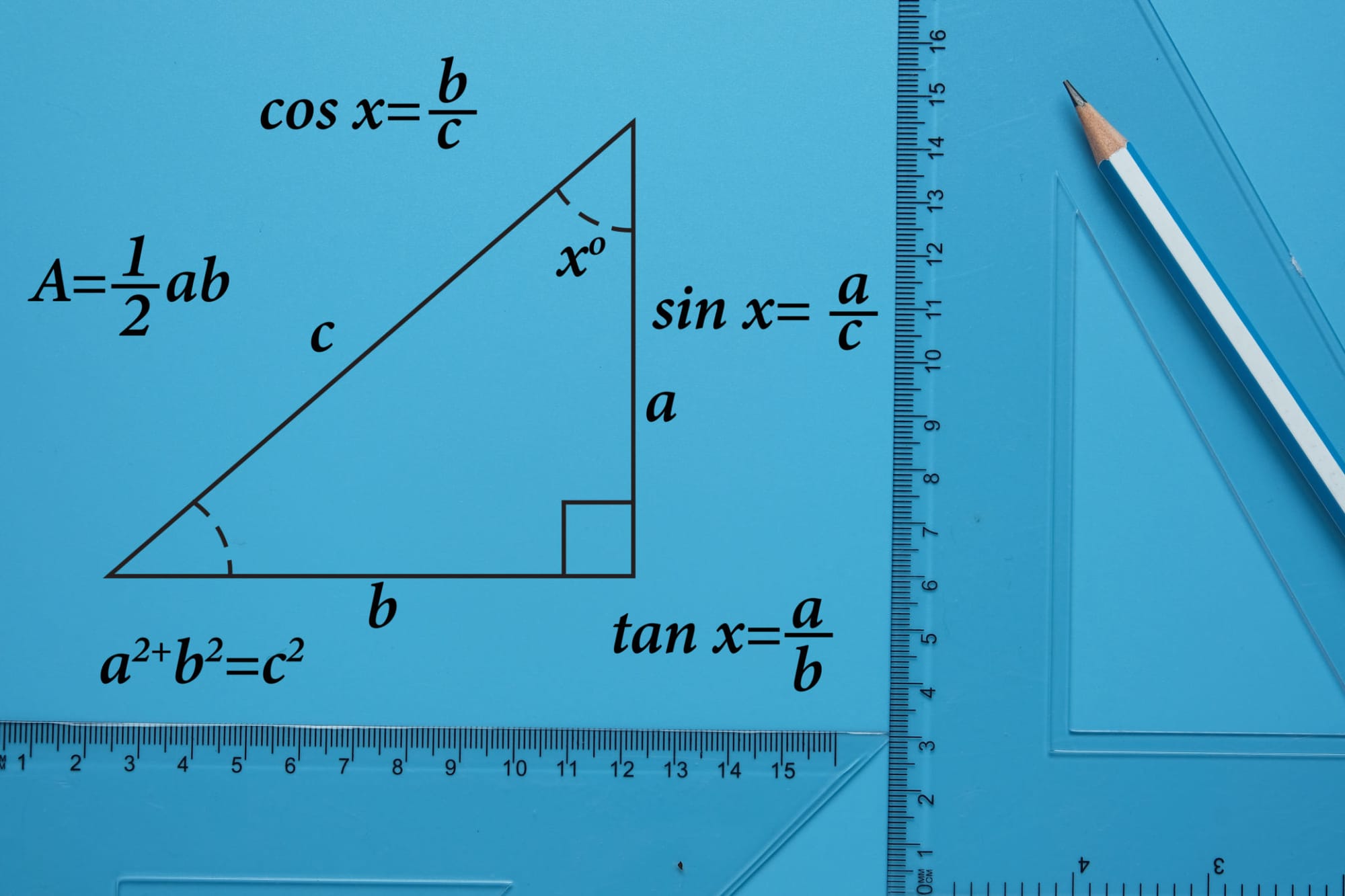 Pillar 5: Trigonometry (Triangles and Waves)
Right-Angled Trigonometry (SOH CAH TOA):
- Content: Using Sine, Cosine, and Tangent ratios to find missing sides or angles in right-angled triangles.
- Why it matters: Used in navigation, surveying land heights, and physics vectors.
Non-Right-Angled Trigonometry:
- Content: The Sine Rule and the Cosine Rule for solving any triangle. The area of a triangle using $1/2 ab \sin(C)$.
- Why it matters: Solving complex surveying or navigation problems where right angles don't exist.
Pillar 6: Probability and Statistics (Data and Chance)
 How to understand data and deal with uncertainty.
Collecting and Representing Data:
- Content: Types of data (discrete vs. continuous). Drawing Bar charts, Pie charts, Histograms, and Cumulative frequency graphs.
- Why it matters: We live in an age of "Big Data." Visualizing it correctly is crucial to avoid being misled.
Statistical Measures (Averages and Spread):
Content: Calculating Mean, Median, and Mode (averages). Calculating Range and Interquartile Range (spread/consistency of data).
- Why it matters: Summarizing large sets of data into understandable numbers (e.g., "average house price")
Probability Basics:
- Content: The probability scale (0 to 1). Calculating probabilities of single events (rolling dice, picking cards). relative frequency (experimental probability).
- Why it matters: Assessing risk and chance.
Combined Events Probability:
- Content: Tree diagrams and Venn diagrams. "AND" rules (multiplying) and "OR" rules (adding). Conditional probability (probability given something else has already happened).
- Why it matters: Calculating more complex risks (e.g., weather forecasting, insurance).
